AXI4-Lite Ordered Response Design#
Release and terminology#
This design is available in 0.8.0. The generated module exposes an AXI4-Lite
Subordinate interface (s_axil) to the
upstream Manager and one AXI4-Lite Manager interface (m_axil_*) per
downstream Subordinate. Source identifiers retain the older slave and
master names.
AXI4-Lite has no transaction IDs, so all reads share one ordering domain and all writes share another. The behavior sometimes described as “out-of-order slave ordering” is therefore same-direction response ordering across downstream Subordinates: children may become ready to respond in any order, but the decoder emits responses in upstream request-acceptance order.
Ordering contract#
The decoder enforces these rules independently for reads and writes:
A read enters the order at the upstream
ARVALID && ARREADYhandshake.AWandWare accepted independently and paired in their respective acceptance sequence. A write enters the response order when both beats of the next pair have been accepted.Each accepted transaction retains one decoded destination or a local-error marker, plus the request payload required for downstream dispatch.
If request i precedes request j, response j is not presented upstream until response i completes its upstream
VALID && READYhandshake.A presented response and its payload remain stable until that handshake.
A local
DECERRoccupies its normal position. It cannot pass an older child response, and a younger child response cannot pass it.Reads and writes have no order relative to one another.
Reset flushes holding registers and both order queues, deasserts upstream response
VALID, and prevents a stale child response from being consumed.
The same contract covers repeated requests to one child. AXI4-Lite requires that child to produce its responses in request order; the decoder dispatches requests FIFO and associates the child’s next response with the oldest entry for that destination.
Response sequence#
Only the child named by the queue head receives response READY. A faster
later child holds its response until older work completes.
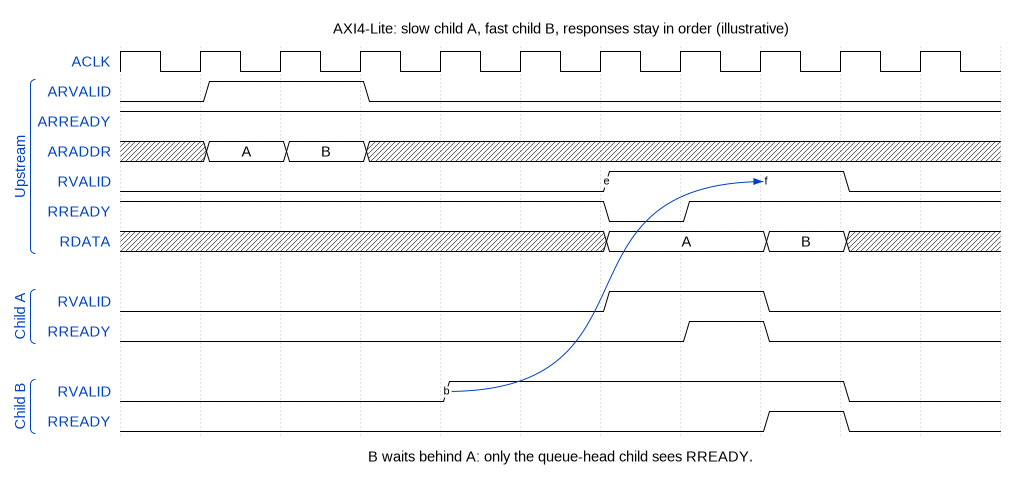
Same-direction ordering: child B’s earlier response waits behind A, and the presented response stays stable under upstream back-pressure.#
The timing diagram is illustrative; exact latencies depend on the implementation and the children.
        sequenceDiagram
    participant U as Upstream Manager
    participant D as Ordered decoder
    participant A as Child A
    participant B as Child B
    U->>D: Accept request A (order 0)
    D->>A: Issue request A
    U->>D: Accept request B (order 1)
    D->>B: Issue request B
    B-->>D: B VALID first
    D-->>B: B READY remains low
    A-->>D: A VALID
    D-->>A: A READY follows upstream READY
    D-->>U: Response A handshake
    D-->>B: B READY may now assert
    D-->>U: Response B handshake
Head-of-line blocking in this sequence is intentional and required to preserve AXI4-Lite ordering.
Microarchitecture#
The implementation has separate circular read and write queues. Each queue has three logical positions:
a tail where newly accepted request metadata is stored;
an issue pointer that holds the current downstream request stable through its request-channel handshake; and
a response head that alone controls the upstream response mux and downstream response
READY.
The write side additionally has independent one-entry AW and W holding
registers. A queue entry records separate downstream AW-sent and W-sent
bits, because the selected child may accept those channels in different
cycles.
Response payload RAM is not required. A non-head child is back-pressured and,
as required by AXI, retains its response VALID and payload. The response
fanin mux selects the queue-head child; the upstream READY is propagated
only to that child. Local errors synthesize a head response with DECERR.
The figure uses the same conventions as Bus Decoder Architecture: blue paths carry requests, dashed green paths carry responses, red marks locally generated errors, and orange marks state retained per transaction.
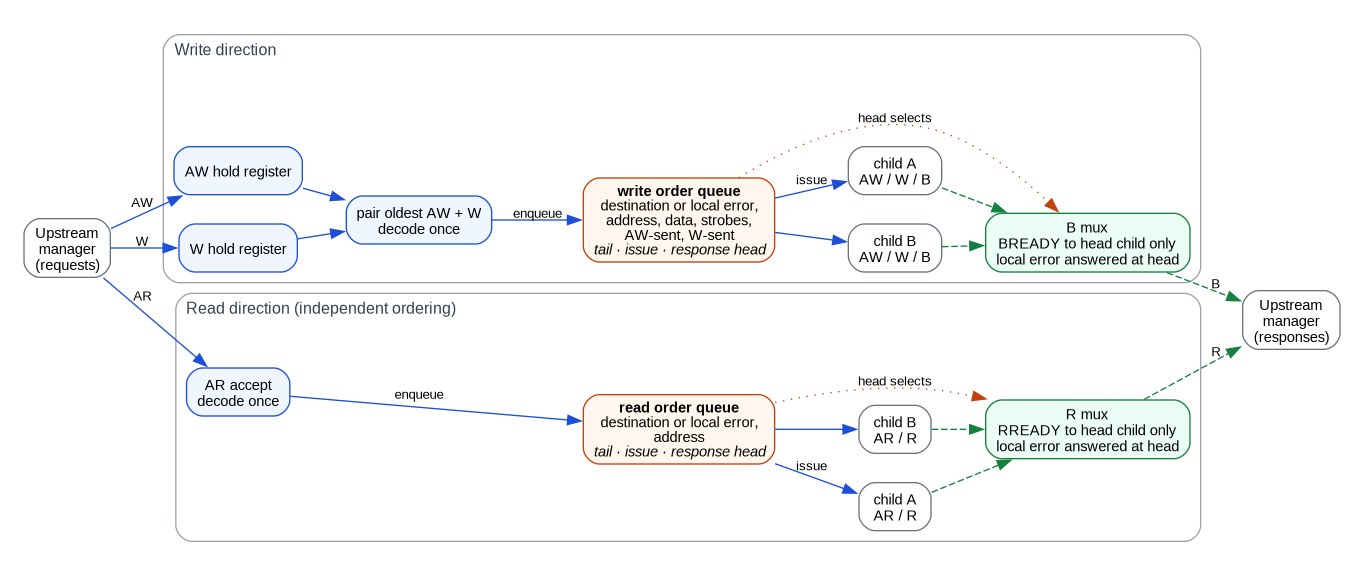
Ordered AXI4-Lite structure: independent read and write queues.#
        stateDiagram-v2
    [*] --> Queued: upstream request accepted
    Queued --> Issuing: mapped destination reaches issue pointer
    Issuing --> Issuing: child READY low / hold request stable
    Issuing --> AwaitResponse: child request handshake complete
    Queued --> AwaitHead: local decode error
    AwaitResponse --> AwaitResponse: not queue head / child READY low
    AwaitResponse --> Visible: queue head and child VALID
    AwaitHead --> Visible: entry reaches queue head
    Visible --> Visible: upstream READY low / hold payload stable
    Visible --> [*]: upstream response handshake
Generated implementation boundaries#
cpuif/axi4lite/axi4_lite_tmpl.sv owns the holding registers, circular
queues, issue/response pointers, request acceptance, reset, and upstream
responses. axi4_lite_cpuif.py generates per-child request fanout, selective
response READY, response fanin, and interface-array intermediates. The
existing address decoder produces cpuif_sel_t destination metadata only at
queue insertion; outstanding requests never depend on a live upstream address.
--axi4lite-max-outstanding selects the fixed queue depth and defaults to
four. The configured capacity is applied independently to the read and write
queues.
Operational constraints#
Request dispatch is FIFO per direction and handles one downstream request at a time. Multiple fully issued transactions may await responses concurrently.
The adapter relies on every child obeying AXI’s rule that
VALIDand its payload remain asserted and stable untilREADY.Reset intentionally abandons pre-reset transactions. The surrounding system must reset downstream children consistently so pre-reset responses are not reintroduced as post-reset traffic.
Queue depth bounds accepted work and destination metadata. Full queues deassert upstream request
READYuntil a response is removed.
Verification coverage#
The integration suite includes focused Cocotb cases for independently ordered
AW/W handshakes, simultaneous read/write progress, upstream response
back-pressure and payload stability, cross-child and same-child delayed
responses, ordered local DECERR, and reset recovery from partial writes
and full queues. Flat and SystemVerilog interface smoke cases exercise
queue depths one, three, and four, including full/drain/refill and pointer
wraparound. Wider upstream interface tests verify that high address bits
produce DECERR rather than aliasing a low mapped address. Rolled arrays,
variable decode depth, and randomized upstream write-channel order are also
covered by the test cases. Exporter validation rejects nonpositive queue
capacities. This inventory describes finite RTL simulation coverage, not a formal
proof or a verification receipt for a particular release artifact.