AMBA APB#
Both APB3 and APB4 standards are supported.
With the default --apb-buffer none, omitting --clk-src selects off.
The unbuffered decoder preserves the clockless 0.7.x port shape: no
clk/rst ports, no standalone PCLK/PRESETn ports, and no
clock/reset forwarding or sequential state. Explicit --clk-src off selects
the same behavior.
Opting into --clk-src design adds input clk/rst ports; flat APB
ports still omit PCLK/PRESETn. With --clk-src cpuif, flat variants
instead add upstream s_apb_PCLK/s_apb_PRESETn inputs and pass-through
clock/reset outputs for every child, without separate clk/rst ports.
These clock-source choices do not add latency to unbuffered APB.
The bundled SystemVerilog interfaces retain PCLK/PRESETn members.
Those members are inputs on both modports: connect every interface instance
externally to the same selected domain. The decoder neither uses nor forwards
them in off mode; design uses its separate input ports instead.
Buffered APB selects design automatically when the clock-source option is
omitted, as described below.
With --apb-buffer none, an unmapped address completes with an error in the
first access cycle. The decoder asserts PREADY and PSLVERR together only
when PSEL and PENABLE are high; both remain low during setup and while
unselected.
Mapped transfers pass through the selected endpoint’s response signals.
Back-to-back transfers may keep PSEL high, but each transfer requires a
SETUP phase with PENABLE low between ACCESS phases. These are individual
APB transfers, not bursts. With --apb-buffer none, the decoder is
combinational and does not retain transactions; buffering is opt-in.
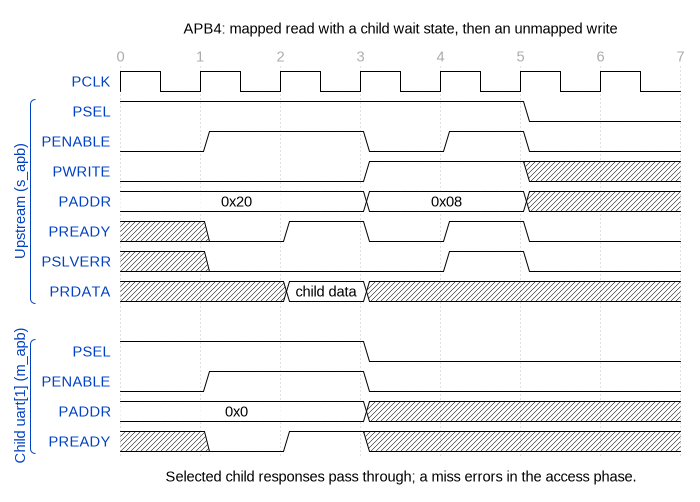
APB4 through the decoder: a mapped read with a child wait state, then an
unmapped write. APB3 behaves the same without PPROT/PSTRB.#
Warning
Some IP vendors will incorrectly implement the address signalling
assuming word-addresses. (that each increment of PADDR is the next word)
For this exporter, values on the interface’s PADDR input are interpreted
as byte-addresses. (an APB interface with 32-bit wide data increments
PADDR in steps of 4 for every word). Even though APB protocol does not
allow for unaligned transfers, this is in accordance to the official AMBA
specification.
Be sure to double-check the interpretation of your interconnect IP. A simple bit-shift operation can be used to correct this if necessary.
APB3#
Implements the bus decoder using an AMBA 3 APB CPU interface.
The APB3 CPU interface comes in two i/o port flavors:
- SystemVerilog Interface
Command line:
--cpuif apb3Interface Definition:
apb3_intf.svClass:
peakrdl_busdecoder.cpuif.apb.APB3Cpuif
- Flattened inputs/outputs
Flattens the interface into discrete input and output ports.
Command line:
--cpuif apb3-flatClass:
peakrdl_busdecoder.cpuif.apb.APB3CpuifFlat
APB4#
Implements the bus decoder using an AMBA 4 APB CPU interface.
APB4 managers must drive PSTRB to zero for reads. By default, writes
broadcast the manager’s byte strobes directly to downstream interfaces;
--gate-signals optionally masks the payload of unselected children.
The APB4 CPU interface comes in two i/o port flavors:
- SystemVerilog Interface
Command line:
--cpuif apb4Interface Definition:
apb4_intf.svClass:
peakrdl_busdecoder.cpuif.apb.APB4Cpuif
- Flattened inputs/outputs
Flattens the interface into discrete input and output ports.
Command line:
--cpuif apb4-flatClass:
peakrdl_busdecoder.cpuif.apb.APB4CpuifFlat
Broadcast Signal Gating#
PENABLE is always masked with each slave’s select expression, so unselected
slaves hold it low. By default, the payload signals PADDR, PWDATA,
PSTRB, and PPROT fan out to every master port without select masking,
keeping the master-to-slave datapath free of extra mux stages. Conformant
slaves only sample these signals while their PSEL is asserted.
Passing --gate-signals also masks each payload signal with the slave’s
select expression, so unselected slaves see all-zero payload inputs. This
costs one extra mux stage on the datapath, but reduces switching activity on
quiet sub-blocks (power/EMI), produces cleaner debug waveforms, and defends
against non-conformant slaves that latch inputs without checking PSEL.
PSEL, PENABLE, and PWRITE are unaffected by this option.
Transaction-Aware Buffering#
--apb-buffer selects request and response buffering around the APB decoder.
It is not an unconditional delay of the interface signals:
none(default): the existing combinational request and response paths, without transaction state or added latency.in: captures the request payload at the rising clock edge ending upstream SETUP (PSEL && !PENABLE), then holds it while issuing one downstream SETUP followed by ACCESS. The retained payload isPWRITE,PADDR,PWDATA, and, for APB4,PSTRBandPPROT. The response remains combinational during downstream ACCESS, so the child and upstream transfer complete on the same edge.out: uses the live upstream payload, which the APB master must hold through completion, and forwards upstream SETUP/ACCESS to the selected child. At child completion it capturesPRDATA,PSLVERR, and ready status, immediately removes downstreamPSEL/PENABLE, and holds the registered response until upstreamPSEL && PENABLE && PREADYacceptance.both: combines the retained request and registered response stages.
Every buffered mode tracks ownership of one transaction. A selected child completes exactly once; retaining an upstream ACCESS while a registered response is pending does not replay the child transfer. There are no multiple outstanding transfers.
For a child with no wait states, timing measured at the upstream interface is:
Mode |
ACCESS cycles through completion |
Minimum cycles between completions |
|---|---|---|
|
1 |
2 |
|
2 |
3 |
|
2 |
3 |
|
3 |
4 |
Completion spacing includes the mandatory upstream SETUP cycle between
back-to-back transfers, even when PSEL stays high. Each child wait cycle
adds one cycle to both counts. Unmapped requests use the same buffering stages
around the local ACCESS-phase error response.
Buffered modes require --clk-src design. Omitting --clk-src selects it
automatically for in, out, and both; explicit off or cpuif
with buffering is rejected. Omit the clock-source option, select design,
or use --apb-buffer none to return to unbuffered routing. Buffered modes
use design clk and active-high asynchronous rst. Reset clears retained
request/response state, suppresses downstream requests and upstream ready, and
aborts a pending transfer. It cannot undo downstream side effects that already
completed.
After reset, the upstream master must restart with a fresh SETUP; a stale
ACCESS held across reset is not replayed. These reset rules apply to buffered
modes, not to the unchanged combinational none path.
Non-APB CPU interfaces reject non-none buffering. Buffering does not change
the clock-distribution or --gate-signals contracts described above.