AMBA AHB-Lite#
The AHB-Lite adapter implements a single-manager router with one subordinate interface and a manager-side interface for each decoded target. It follows the classic AHB-Lite profile in the Arm AMBA AHB Protocol Specification, IHI 0033C. It does not implement multi-manager arbitration, SPLIT/RETRY, AHB5 exclusives, security extensions, data-width conversion, or burst-address generation.
This adapter is available in 0.8.0.
- SystemVerilog interface
Command line:
--cpuif ahb-liteInterface definition:
ahblite_intf.svClass:
peakrdl_busdecoder.cpuif.ahblite.AHBLiteCpuif
- Flattened inputs/outputs
Command line:
--cpuif ahb-lite-flatClass:
peakrdl_busdecoder.cpuif.ahblite.AHBLiteCpuifFlat
For example:
peakrdl busdecoder design.rdl -o busdecoder/ --cpuif ahb-lite-flat
Both forms support rolled arrays and --unroll, including targets nested
inside arrayed blocks.
Signals, clock, and reset#
The subordinate interface is named s_ahb in the interface form; flat signals
have the prefix s_ahb_. Ingress address/control signals are HSEL,
HREADY, HADDR, HTRANS[1:0], HWRITE, HSIZE[2:0],
HBURST[2:0], HPROT[3:0], and HMASTLOCK. HWDATA carries write
data. The router returns HRDATA, HREADYOUT, and one-bit HRESP
(0 = OKAY, 1 = ERROR). Each child receives the same address/control and data
signal set and supplies its own response signals.
Unlike the default unbuffered APB adapter, this adapter has sequential state:
Flat ports include
s_ahb_HCLKand active-lows_ahb_HRESETn.ahblite_intftakesHCLKandHRESETnas interface-constructor inputs. Connect the same clock and reset externally to the subordinate and every child interface instance. These signals are inputs in both modports; the router does not distribute clocks or resets through child output ports.All endpoints must operate in that one clock domain. There is no clock-domain crossing logic.
HRESETnasynchronously clears the pending data-phase destination and local-error state. During reset, all childHSELoutputs are low and the subordinate returnsHREADYOUT=1,HRESP=0, and zero read data. The canonicalHRESETninput is used regardless of RDLcpuif_resetmetadata.--clk-src designand--clk-src cpuifare accepted but ignored: neither changes the AHB clock/reset ports or adds genericclk/rstports. Explicit--clk-src offis rejected because data-phase state requires ingressHCLK/HRESETn. Omit the option or select either accepted setting; the ingress clock/reset wiring is always required.
Important
HREADY is the global bus-ready feedback, not a synonym for
HREADYOUT. Connect the router’s HREADY input to the system’s selected
data-phase ready signal. In a system where this router is the only
subordinate, that feedback is its own HREADYOUT. The router broadcasts
this global HREADY to every child; do not connect a child to its own
HREADYOUT instead.
Instantiate the interface form with the generated package widths. For example,
for a scalar child named peripheral in a module named router:
import router_pkg::*;
ahblite_intf #(
    .ADDR_WIDTH(ROUTER_MIN_ADDR_WIDTH),
    .DATA_WIDTH(ROUTER_DATA_WIDTH)
) upstream (.HCLK(clk), .HRESETn(reset_n));
ahblite_intf #(
    .ADDR_WIDTH(ROUTER_PERIPHERAL_ADDR_WIDTH),
    .DATA_WIDTH(ROUTER_DATA_WIDTH)
) peripheral (.HCLK(clk), .HRESETn(reset_n));
router decoder (.s_ahb(upstream), .m_ahb_peripheral(peripheral));
The generated interface adapter includes initial assertions checking each endpoint’s address and data widths. Enable assertions in the simulator to exercise them. Flat ports encode these widths in their declarations.
Address apertures and widths#
AHB-Lite subordinate regions must start and end on 1 KiB boundaries. The exporter rejects a decoded target unless:
Its local base is a multiple of 1024 bytes.
Its element size is at least 1024 bytes and a multiple of 1024 bytes.
Every array stride, including ancestor-array strides, is a multiple of 1024 bytes.
The configured ingress address width represents the complete aperture.
Sizes need not be powers of two. Every child receives a byte address relative to its own element base, including non-power-of-two apertures and unrolled arrays. A standalone sub-addrmap export uses addresses local to that exported root, not its original parent placement. Array-stride holes are unmapped; the router does not silently widen apertures to cover them.
Small register maps must be contained in explicitly sized, 1 KiB-or-larger
downstream blocks. Selecting individual small registers with
--max-decode-depth is rejected instead of rounding their ranges. An external
memory with 256 32-bit entries, for example, has a 1024-byte aperture; use an
accurate downstream model rather than changing the actual register addresses.
Invalid aperture and data-width layouts produce source diagnostics before RTL
is written. The normal opaque-block boundary rules still apply: a block whose
addressable children are all external remains a downstream target even when a
deeper decode depth is requested.
The data width is common to all endpoints and is selected or inferred using the
usual bus-width rules. Supported widths are 32, 64, 128, 256,
512, and 1024 bits. Narrower or wider buses are rejected; 1024 bits is the
largest transfer represented by the three-bit HSIZE field. The router does
not adapt a downstream bus of a different width.
Router structure#
AHB-Lite overlaps the address phase of one transfer with the data phase of the previous one. The decoder therefore separates live address-phase selection from a registered data-phase owner that alone selects the response.
The figures use the same conventions as Bus Decoder Architecture: blue paths carry requests, dashed green paths carry responses, red marks locally generated errors, and orange marks state retained per transaction. Timing diagrams are illustrative; exact latencies depend on the implementation and the children.
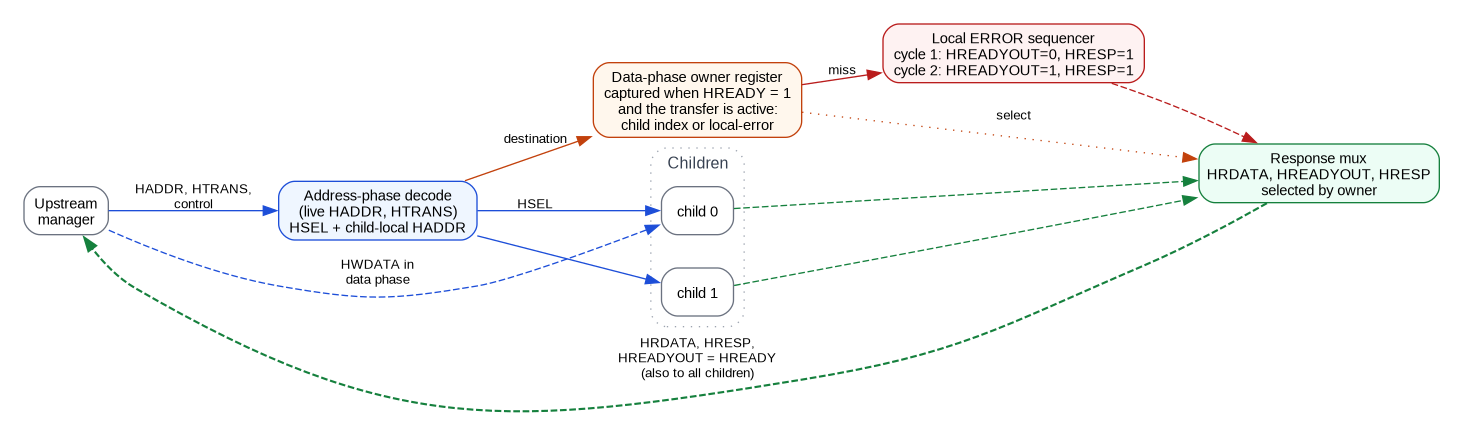
AHB-Lite structure: combinational address phase, registered data-phase owner.
The illustrated ready feedback assumes the router is the only subordinate;
otherwise use the system’s selected global HREADY as described above.#
Address and data phases#
An address is accepted on a rising HCLK edge only when HRESETn,
HREADY, HSEL, and HTRANS[1] are high. Thus NONSEQ and SEQ transfers
are active; IDLE and BUSY are bubbles. Each active burst beat is decoded
independently. The manager is responsible for burst-address progression and
legal burst boundaries.
Child HSEL is an address-phase decode and is not gated by HREADY.
The router retains the accepted destination for the following data phase, so
changes in the next address cannot retarget an older response. While
HREADY=0, the destination and direction are held. A completed data phase
and a new address may share an edge: zero-wait children can sustain one beat
per cycle without a mandatory bubble.
HADDR, HTRANS, HWRITE, HSIZE, HBURST, HPROT, and
HMASTLOCK are forwarded in the address phase. HWDATA is forwarded
live, not captured with the address: its value belongs to the preceding
accepted write and must be held by the manager during that write’s wait states.
There is no write-strobe signal or byte-lane conversion.
The retained child alone supplies HRDATA, HREADYOUT, and HRESP.
Its wait states and legal two-cycle ERROR response pass through unchanged.
With no pending data phase the router returns ready/OKAY and zero read data.
An IDLE, BUSY, or unselected address clears the pending marker only on an
HREADY=1 edge; it never discards a stalled data phase.
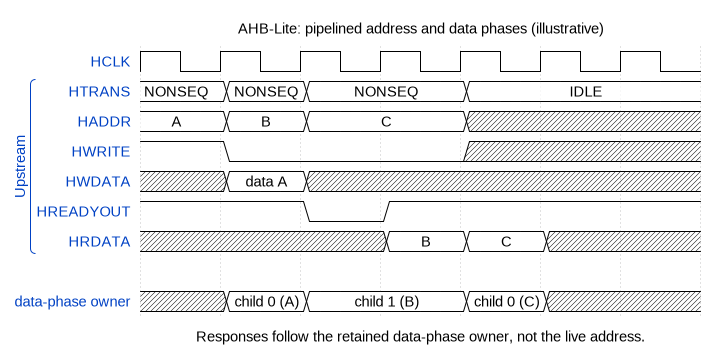
Pipelined phases: the response follows the data-phase owner, and write data is forwarded in its data phase.#
An accepted address that selects no permitted target produces a local two-cycle ERROR response:
First data-response cycle:
HREADYOUT=0,HRESP=1.Second data-response cycle:
HREADYOUT=1,HRESP=1.
Local-error read data is zero and the denied address asserts no child HSEL.
The error phase advances across the first forced wait cycle even though global
HREADY is low. The following address can be cancelled according to AHB-Lite
error timing, and the next active address is accepted only when HREADY is
high. Unmapped IDLE/BUSY phases do not create errors.
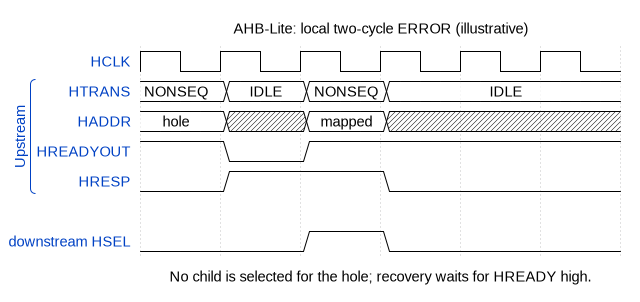
An unmapped address receives the required two-cycle ERROR response.#
Where a decode target is a register, reads require a present software-readable
field and writes require a present software-writable field. Opaque block targets
route both directions; their downstream implementation enforces field
permissions and side effects. HPROT is forwarded, not interpreted as an
authorization policy.
The router assumes legal manager/child timing, supported and aligned transfer sizes, stable active address/control and write data during stalls, and legal child ERROR sequencing. It is not a protocol firewall and does not validate malformed traffic. A child that never becomes ready can stall its pending transaction indefinitely.
Target names and arrays#
AHB uses the same target-name allocator as APB and AXI4-Lite. A unique local
target name is retained, so outer.inner normally uses m_ahb_inner,
m_ahb_inner_HSEL, and ROUTER_INNER_ADDR_WIDTH. Repeated or case-folded
names are disambiguated with flattened relative paths and deterministic suffixes;
reserved package names are also disambiguated. See Bus Decoder Architecture.
Rolled ports collect all ancestor and target dimensions in outer-to-inner order.
For example, a uniquely named target outer[2].inner[3] produces flat signals
such as m_ahb_inner_HSEL[2][3] and interface port m_ahb_inner[2][3].
With --unroll, element [0][1] uses m_ahb_inner_HSEL_0_1 and
m_ahb_inner_0_1. Address-width constants are emitted once per target
identity rather than repeated for each unrolled element. A collision between
fully expanded unrolled public-port names is diagnosed.
Physical array dimensions retain their elaborated maximum sizes. When
--parametrize exposes root-level array-enable parameters, disabled elements
remain unselected and accesses to them receive the local two-cycle ERROR;
parameter changes do not resize the public ports.