AMBA AXI4-Lite#
Implements the bus decoder using an AMBA AXI4-Lite CPU interface.
The stateful ordering implementation is available in 0.8.0.
The AXI4-Lite CPU interface comes in two i/o port flavors:
- SystemVerilog Interface
Command line:
--cpuif axi4-liteInterface Definition:
axi4lite_intf.svClass:
peakrdl_busdecoder.cpuif.axi4lite.AXI4LiteCpuif
- Flattened inputs/outputs
Flattens the interface into discrete input and output ports.
Command line:
--cpuif axi4-lite-flatClass:
peakrdl_busdecoder.cpuif.axi4lite.AXI4LiteCpuifFlat
Clock and reset#
AXI4-Lite always requires an operational clock/reset for its holding registers
and ordered-response queues. Omitting --clk-src (or using Python
clk_src=None) selects design and adds top-level clk and active-high
asynchronous rst inputs. --clk-src cpuif instead uses upstream
ACLK/ARESETn without separate clk/rst ports. Flat cpuif
variants expose those protocol inputs and pass-through outputs for each child;
SystemVerilog interface instances must receive the common clock/reset
externally. Explicit --clk-src off is rejected: omit the option or select
design or cpuif and connect that source. See Introduction for
wiring and Migrating from 0.7.x for the change from the 0.7.4 AXI adapter.
Protocol behavior#
The adapter implements stateful AXI4-Lite handshakes in the read and write directions independently.
Upstream
AWandWbeats may arrive in either order. One holding register per channel retains them until they form a complete write request.Downstream
AW,W, andARVALIDsignals and payloads remain stable until the selected child asserts the correspondingREADY. DownstreamAWandWhandshakes are independent.Accepted requests retain their decoded destination and translated request payload. Changing the upstream address after its handshake cannot redirect an outstanding transaction.
Reads and paired writes use separate bounded order queues. The default depth is four transactions per direction. When a queue is full, the corresponding upstream request
READYis deasserted.Read responses are returned in
ARacceptance order. Write responses are returned in completedAW/Wpair order. A later, faster child cannot overtake an older response.RVALID/RDATA/RRESPandBVALID/BRESPremain stable while the upstreamREADYis low. Only the child that owns the response-queue head receives downstreamRREADYorBREADY.Child
RRESPandBRESPvalues are propagated unchanged. Unmapped requests complete locally withDECERR(2'b11) in their normal FIFO position. A wider upstream SystemVerilog interface address with nonzero bits above the configured decoder address width also returnsDECERR, rather than aliasing a low mapped address. Flat upstream ports already have the configured width.Reset clears partial
AW/Wcaptures and both queues. All connected children must share the reset domain so abandoned responses cannot reappear as post-reset transactions.
AXI4-Lite is single-beat and has no transaction IDs. Reads and writes are
separate ordering domains: an R response and a B response have no
ordering relationship and may complete in the same cycle.
This is AXI4-Lite support, not full AXI4. AXI4 transaction IDs, bursts, exclusive accesses, and cross-ID response reordering are not implemented. Read and write channels share the exported SystemRDL layout; generating standalone directional decoders from different layouts is not an exporter option in this release. AXI4-Lite standard data widths are 32 and 64 bits. Other generator-inferred widths are implementation extensions, not a claim of AXI4-Lite compliance; both endpoints must explicitly support the extension.
Write request acceptance#
The timing example below shows both arrival orders for AW and W.
Each accepted pair records its destination (or a local-error marker), so a
later address never redirects an older response. Timing diagrams are
illustrative; exact latencies depend on the implementation and the children.
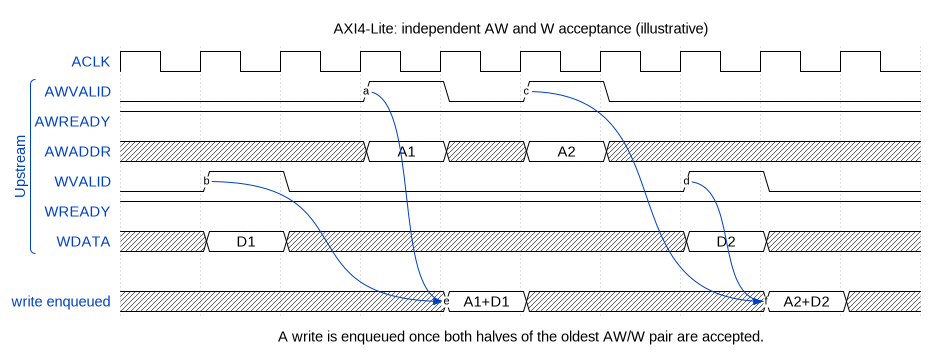
AW and W may arrive in either order or on different cycles.#
Outstanding depth#
Set the queue capacity with --axi4lite-max-outstanding on the command line:
peakrdl busdecoder design.rdl -o out \
    --cpuif axi4-lite --axi4lite-max-outstanding 8
The equivalent Python exporter keyword is axi4lite_max_outstanding. Values
must be at least one. The depth applies separately to accepted reads and paired
writes; the default is four.
Handshake and back-pressure details#
Request dispatch is FIFO within each direction. This is stricter than routing requests to different children in parallel, but it keeps destination and response association unambiguous without AXI IDs. Once dispatched, multiple children may have responses pending concurrently.
Response ordering intentionally creates head-of-line blocking. If child B has
a response ready for a later request while older child A is still pending, B’s
READY remains low. AXI requires B to retain its VALID and payload. Once
A’s response handshakes upstream, B becomes the queue head and can proceed.
The one-entry AW and W holding registers favor simple, deterministic
control over maximum write-channel throughput. A channel is not re-accepted
while its holding register is occupied. Read and write traffic otherwise make
progress independently.
See AXI4-Lite Ordered Response Design for the ordering contract, microarchitecture, and sequence diagrams.